

Intubation Healthcare
Weitlaner Self-Retaining Retractor
Weitlaner Self-Retaining Retractor
Couldn't load pickup availability
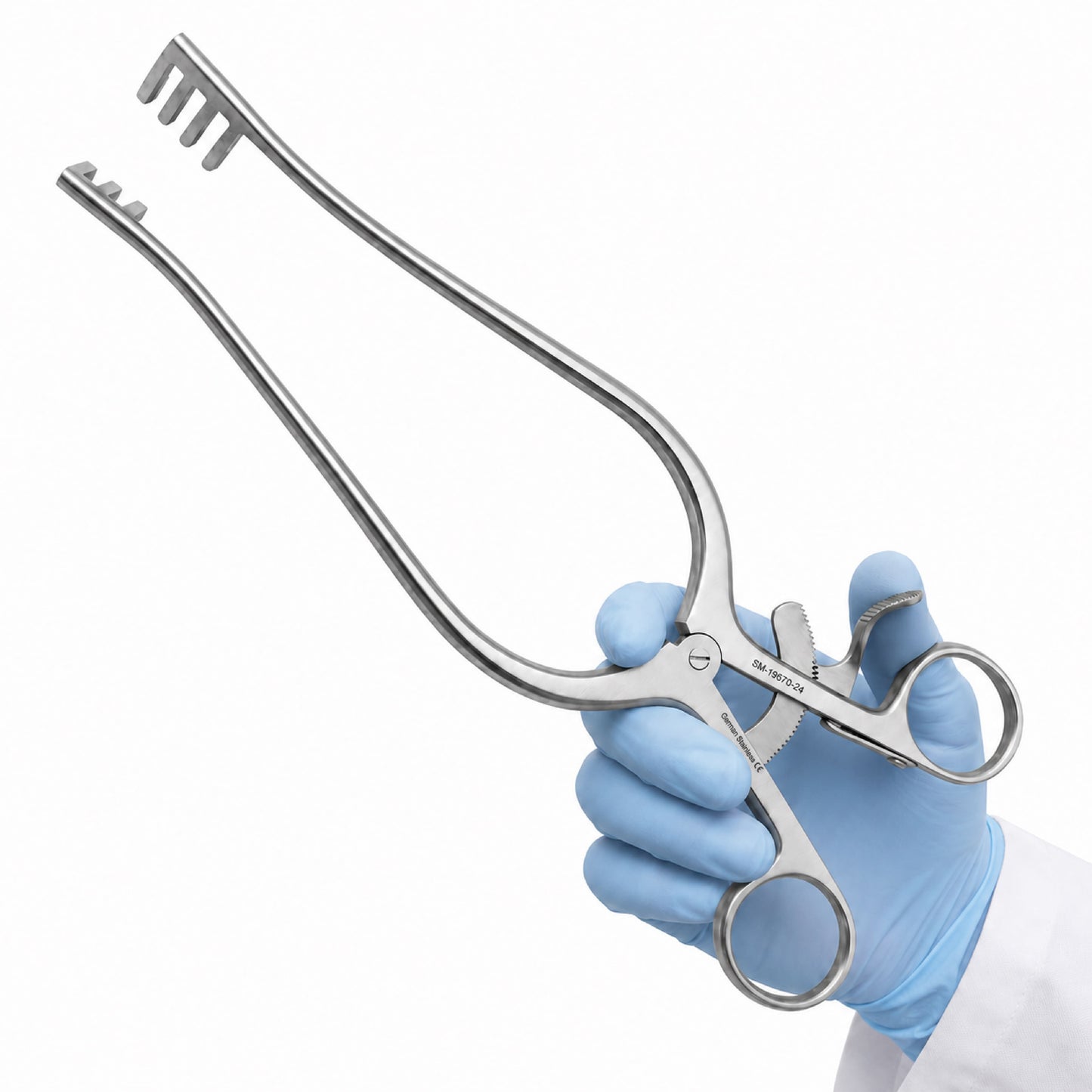
Weitlaner Self-Retaining Retractor is a professional surgical instrument designed to hold incision margins and soft tissue apart while maintaining clear access to the operative field. Its self-retaining construction allows the selected opening to remain secured without continuous manual holding.
This Weitlaner retractor range includes a compact 11.5cm blunt 2×3-prong configuration and four sharp 3×4-prong configurations in 14cm, 16.5cm, 20cm, and 24cm lengths. These options allow healthcare professionals to select the appropriate prong profile, reach, and overall instrument size for the planned procedure.
Explore additional professional surgical equipment from Intubation Healthcare Inc.
Key Features
- Self-retaining design: Maintains tissue separation without requiring continuous manual support.
- Ratchet locking mechanism: Allows the professional to adjust and secure the required opening.
- Finger-ring handles: Support controlled opening, closing, positioning, and release.
- Interdigitating prongs: Designed to close together in an organized profile when the instrument is not expanded.
- Sharp and blunt options: Available for different tissue-contact and procedural requirements.
- Multiple lengths: Choose from 11.5cm, 14cm, 16.5cm, 20cm, and 24cm.
- Reusable construction: Intended for professional cleaning, inspection, and sterilization under validated facility protocols.
- Versatile surgical application: Suitable for procedures requiring stable soft-tissue retraction and improved operative access.
Available Variants
| SKU | Configuration | Selection Guidance |
|---|---|---|
| Sm-19651-10 | Blunt 2×3 Prongs – 11.5cm | A compact self-retaining configuration with blunt prongs for smaller operative areas where a non-sharp contact profile is preferred. |
| Sm-19670-14 | Sharp 3×4 Prongs – 14cm | A compact sharp-prong option for procedures requiring secure tissue engagement and close instrument handling. |
| Sm-19670-16 | Sharp 3×4 Prongs – 16.5cm | A medium-length configuration offering a practical balance of reach, visibility, and handling control. |
| Sm-19670-20 | Sharp 3×4 Prongs – 20cm | An extended configuration for procedures requiring additional reach and stable sharp-prong retraction. |
| Sm-19670-24 | Sharp 3×4 Prongs – 24cm | The longest available option for deeper operative access and extended instrument reach. |
Product Specifications
- Product Name: Weitlaner Self-Retaining Retractor
- Instrument Type: Self-Retaining Surgical Tissue Retractor
- Pattern: Weitlaner
- Available Lengths: 11.5cm, 14cm, 16.5cm, 20cm, and 24cm
- Prong Configurations: Blunt 2×3 and Sharp 3×4
- Handle Style: Finger-Ring Handles
- Locking System: Adjustable Ratchet Mechanism
- Material: Stainless Steel
- Use Type: Reusable Professional Surgical Instrument
- Package Includes: One Weitlaner retractor in the selected configuration
Understanding the Prong Configuration
The designation 2×3 means that one retractor arm has two prongs and the opposing arm has three prongs. The designation 3×4 means that one arm has three prongs and the opposing arm has four prongs.
The asymmetrical arrangement allows the opposing prongs to interdigitate as the instrument closes. Prong count should not be interpreted as the total number of prongs on each individual side.
Sharp vs. Blunt Prongs
Blunt 2×3 Prongs
The blunt-prong configuration provides a rounded tissue-contact profile without pointed penetrating tips. The compact 11.5cm length is intended for procedures requiring a smaller self-retaining instrument and controlled access to a limited operative field.
Sharp 3×4 Prongs
The sharp-prong configuration is designed to provide firmer tissue engagement when clinically appropriate. It is available in four lengths so professionals can select the required balance of close handling, reach, and access.
The appropriate sharp or blunt profile must be selected by the operating professional according to tissue characteristics, surgical depth, anatomy, procedural requirements, and approved technique.
Length Selection Guide
11.5cm Blunt
The shortest configuration offers compact handling for smaller or more accessible operative areas. This variant is supplied with blunt 2×3 prongs.
14cm Sharp
The 14cm version provides a compact sharp-prong configuration for close handling and controlled positioning.
16.5cm Sharp
The 16.5cm version provides a middle-range option for professionals requiring additional reach without moving to a substantially longer instrument.
20cm Sharp
The 20cm version offers extended reach for deeper surgical sites and procedures requiring a longer self-retaining retractor.
24cm Sharp
The 24cm version provides the greatest reach within this product range and may be selected for deeper operative access where the longer configuration is appropriate.
Intended Applications
The Weitlaner Self-Retaining Retractor may be used by appropriately trained healthcare professionals for:
- Holding incision margins apart during surgical procedures.
- Maintaining stable soft-tissue retraction.
- Improving visibility and access to the operative field.
- Selected orthopedic and trauma procedures.
- General and soft-tissue surgery.
- Selected spinal, neurological, plastic, and reconstructive procedures.
- ENT and mastoid procedures where the selected configuration is appropriate.
- Hospital operating rooms, surgical centers, and professional instrument sets.
Browse the complete Surgical Retractors Collection for additional tissue-retraction instruments.
Self-Retaining Ratchet Design
The ratchet mechanism allows the retractor arms to be opened gradually and secured at the required position. This helps maintain consistent tissue separation while allowing the surgical team to work without continuously holding the instrument.
The locking mechanism should be engaged only after the prongs have been positioned correctly and surrounding tissue has been checked. The ratchet should always be released in a controlled manner before removing or repositioning the instrument.
Professional Usage Guidance
- Select the appropriate length, prong count, and sharp or blunt configuration.
- Inspect the prongs, arms, pivot, handles, and ratchet mechanism before use.
- Confirm that the instrument has been cleaned and sterilized under an approved protocol.
- Place the retractor prongs under direct visualization of the operative area.
- Open the handles gradually until the required tissue exposure is achieved.
- Engage the ratchet at the lowest position that provides adequate exposure.
- Monitor the retracted tissue throughout the procedure.
- Release the ratchet gradually before repositioning or removing the instrument.
Important Precautions
- Use sharp-prong variants only where pointed tissue engagement is clinically appropriate.
- Do not position sharp prongs blindly or near structures that cannot be directly assessed.
- Do not apply excessive spreading force or open the retractor beyond the required exposure.
- Do not use the instrument as a clamp, needle holder, lever, or bone-spreading device.
- Confirm that tissue is not trapped within the hinge or ratchet mechanism.
- Do not use the instrument if the prongs are bent, damaged, loose, or misaligned.
- Release the locking mechanism carefully to prevent uncontrolled closure.
Cleaning, Care and Sterilization
- Begin pre-cleaning promptly after use to prevent biological material from drying on the instrument.
- Keep the retractor in an open or unlocked position during cleaning.
- Clean the prongs, inner arm surfaces, pivot joint, ratchet teeth, finger rings, and recessed areas thoroughly.
- Use a neutral-pH detergent approved for reusable stainless-steel surgical instruments.
- Use an appropriate instrument brush to remove debris from the locking teeth and joint areas.
- Rinse thoroughly to remove cleaning-agent residue and loosened contamination.
- Dry the instrument completely before sterilization or storage.
- Apply an approved water-soluble surgical instrument lubricant to the pivot and moving components when required.
- Sterilize according to the applicable product documentation and the healthcare facility’s validated protocol.
- Store with the ratchet released in a clean, dry tray that protects the prongs from impact damage.
Inspection Before Use
Before every procedure, verify that the prongs are aligned and securely attached. Confirm that both arms open and close smoothly and that the ratchet engages and releases at each position. Inspect for corrosion, cracks, loose joints, bent prongs, damaged locking teeth, stiffness, staining, or excessive wear.
Do not use the retractor if its structural integrity, locking performance, cleanliness, alignment, or tissue-contact surfaces appear compromised.
Related Self-Retaining Retractor
For procedures requiring adjustable abdominal exposure, view the Balfour Abdominal Retractor 10″ – Self-Retaining Surgical Instrument.
Share